Green Tau: issue 103

Reshaping how we can talk positively about the climate crisis – part 3:  Transport 

March 2025

How can we talk about the climate crisis in a way that sounds encouraging?

The climate crisis is an existential threat which is certainly not good news. Its causes and impact are diverse and numerous such that it is hard to pin down ‘This is the cause’ or ‘This is the solution’. It is hard to quantify ‘This is how it will effect you’ and ‘This will be the time table.’ 

All this makes it difficult to find a way of talking to people about the crisis and how we might respond.

So here are some thoughts that might help.

Clean Air

Switching from fossil fuels to clean energy* to power road vehicles reduces the amount of pollution that goes into the air we breathe. The pollution from petrol and diesel vehicles includes carbon monoxide, particulate matter and nitrogen oxide and is released into the environment predominately in places where people living, where people are working, where they go to school, where they are simply walking by. Air pollution causes  28,000 and 36,000 early deaths each year in the UK (figures for 2018). Sustrans estimates that road transport is responsible for 80% of roadside NO2 pollution which is where the legal limits are being broken. (1) 

With the growing use of electric vehicles air pollution has fallen …. And without admissions to hospital

In London progressive policies have been put in place to reduce road congestion and more specifically to reduce the air pollution from road vehicles, with the most recent being the expansion of the ultra low emissions zone (ULEZ) to cover all London boroughs in August 2023. Since then pollution from road vehicles across the wool of London has been reduce by 27%. (2) This should lead to a reduction in premature deaths.

Another component of air pollution caused by road vehicles is the fine particulate matter that comes from brake blocks, tyres and even the tarmac. These particles are formed through friction whether that is the brakes slowing the vehicle or the tyres rubbing against the road. Such pollution is known as Non-Exhaust Emissions or NEE. In its report on NNE Defra observed that currently there is no legislation in place to limit this source of air pollution but highlighted possible ways in which such pollution could be reduced, vis:  “The Most effective mitigation strategies for NEE are to reduce the overall volume of traffic, lower the speed where traffic is free-flowing (eg trunk roads and motorways), and promote driving behaviour that rescues braking and higher-speed cornering.”(3)  

As well as ULEZ, London has also benefitted from the widespread introduction of a reduced speed limit for vehicles – from 30 to 20 mph. “An evaluation of 20mph zones in London, carried out by Imperial College, showed slowing traffic had no net negative impact on exhaust emissions. However, in 20mph zones vehicles moved more smoothly, with fewer accelerations and decelerations, than in 30mph zones. This smoother driving style reduces particulate emissions from tyre and brake wear – which still represents a significant cause of air pollution from zero-emission vehicles.” (4)

Switching to electric vehicles, introducing low emissions zones and reduced speed limits, are all contributing to reducing the air pollution that causes so many premature deaths as well as reducing carbon emissions.

Wellbeing 

Active travel includes walking and cycling, and in many cases can replace short car journeys. It can also be combined with the use of public transport (walking to the bus stop or the station) and so replace other longer car journeys. Reducing car journeys reduce carbon emissions and/ or – in terms of electric vehicles – the load on the electric grid. Switching to active travel however also produced significant health benefits (and thus savings for the NHS). 

The Health Foundation notes that “Almost 1,800 early deaths per year could be prevented if activity levels for walking and cycling were to match the most active regions in England.” (5) The most active region was London where people walked and cycled an average of 1.2 miles per day. The Department of Transport estimates that inactivity costs the NHS “up to £1 billion each year, with additional indirect costs of £8.2 billion…” The exercise gained through active travel also has benefits for mental wellbeing. 

The Department for Transport also reports the following further positive benefits of active travel – 

“Increasing active travel will reduce road congestion, particularly at peak times, leading to increased productivity and improved movement of goods and services. Sustrans estimates that congestion costs £10 billion per year in 2009 in urban areas, and that this cost could rise to £22 billion by 2025. Living Streets’ Pedestrian Pound report outlined a range of economic benefits of walking, including that well-planned walking improvements can lead to a 40% increasein shopping footfall.” (6)

Active travel by reducing the amount of road traffic and so reducing air pollution and road congestion, makes for pleasanter local environments – which in itself boosts our sense of wellbeing. . 

*eg electricity produced from renewable energy sources such as wind and solar 

  1. https://www.sustrans.org.uk/our-blog/policy-positions/our-position-on-improving-air-quality/

(2) https://www.standard.co.uk/news/transport/sadiq-khan-ulez-expansion-london-boroughs-biggest-reductions-air-pollution-b1215765.html

(3)  https://uk-air.defra.gov.uk/assets/documents/reports/cat09/1907101151_20190709_Non_Exhaust_Emissions_typeset_Final.pdf

(4) https://www.london.gov.uk/who-we-are/what-london-assembly-does/questions-mayor/find-an-answer/20mph-speed-limit-and-air-pollution

(5) https://www.health.org.uk/evidence-hub/transport/active-travel/health-benefits-of-walking-and-cycling-preventable-early

(6) https://www.gov.uk/government/publications/active-travel-local-authority-toolkit/active-travel-local-authority-toolkit

Counting on … day 8

10th January 2025

Daily travel is an area where we can both reduce adverse effects on the environment and improve our health and wellbeing. Recently the Lancet carried out an extensive piece of research on the co-benefits of active travel. 

The report began -“Private car use contributes substantially to carbon emissions, air pollution, and noise pollution. Furthermore, car dependency fosters a spectrum of health and social issues, including congestion, road injuries and fatalities, psychological distress, and sedentary lifestyles that increase susceptibility to obesity and chronic diseases. Conversely, active travel (also known as active transport or active commuting), which refers to travel behaviour involving physical activity such as walking and cycling to or from destinations, contributes to higher rates of physical activity overall…active travel interventions are likely to yield broader co-benefits, such as environmental (eg, carbon emissions and air pollution), economic (eg, travel costs and productivity), and safety (eg, traffic safety and personal safety) benefits.”

And concluded: “Based on evidence from 80 intervention studies, we have identified an expansive range of co-benefits that extend beyond physical activity, including safety, health, economic, environmental, transport quality, and social outcomes. The consistency of findings was high in favour of the interventions, particularly pertaining to environmental, economic, and transport quality outcomes. Findings from our study highlight the potential for promoting active travel as a promising strategy to jointly address major challenges in contemporary societies, such as traffic safety and road congestion, chronic diseases, fiscal constraints, air pollution, and carbon emissions. Active travel provides a unique opportunity to incorporate regular physical activity into daily life without requiring special skills or substantial monetary or time investments.” https://www.thelancet.com/journals/lanplh/article/PIIS2542-5196(24)00201-8/fulltext

Counting on … day 219

21st November 2024

Any alterations made to reduce carbon emissions need to be sustainable in the long term. Simply switching all combustion engines for electric ones is not sustainable as each new electric engine will make unsustainable demands on rare minerals. Further mining such minerals where they are found in less developed countries often leads to the exploitation of people and pollution of the land. 

Sustainability can be improved by the frequency with which a vehicle is used. A car that spends most of its life parked in the road, is not a sustainable use of limited resources, where as a bus or train that is in frequent use, carry larger numbers of people is a more sustainable option.

Active travel is always a good option with low emissions and significant health benefits!

Counting on …day 6

6th January 2024

Walk, cycle and use public transport

The most environmentally friendly way of getting around is by walking or cycling – and it has the added benefits of being good for our physical and mental health. If you live in an area that is the equivalent of a 15 Minute City (https://greentau.org/2021/07/17/the-green-tau-issue-8-18th-july/) then it is easy to make all your daily journeys to the shops, the doctors, the gym, the school,  the library, the park, the station on foot or by cycling.

Adopting active travel as your default mode of getting around may take a little practice at first. It is also worth sorting out the right clothes and equipment appropriate to different weather conditions, lighting levels and whether you need to carry things like shopping –

Public transport is also an environmentally friendly way of travelling – shared between users it makes best use of resources and road space. Of course it is easier switching from private car to public transport if you live an area with a good public transport network. Maybe experiment with a weekly car-free day or work towards a car-free Lent. 

For further blog entries about active travel – https://greentau.org/tag/active-travel/

The Energy Saving Trust also has a section of its website devoted to active travel – https://energysavingtrust.org.uk/advice/active-travel/

And for thoughts about encouraging active travel for commuters – https://www.cbi.org.uk/articles/returning-to-the-office-five-ways-to-decarbonise-your-team-s-commute/

Counting on …. Day 1.197

19th October 2023

Cycling, walking, taking the train or the bus, all reduce our dependency on cars, and reduces carbon emissions. The more people use these car-alternatives the more likely the provisions of good infrastructure will increase. Equally the more people use car alternatives, the more that others will feel encouraged to do likewise.

Active travel is healthier, more sociable and creates pleasanter environment for everyone. And something we don’t always think about, active travel is good for local businesses. The following is a reasonably unbiased assessment – https://www.talk-business.co.uk/2019/12/02/are-car-free-streets-good-or-bad-for-business/

And this report highlights the value of cycling as industry with green growth potential  – https://www.smarttransport.org.uk/insight-and-policy/active-travel/the-cycle-industry-a-green-growth-sector-that-can-help-deliver-net-zero

Counting on day …1.100

14th April 2023

If more cargo bikes on our streets is a good sign for our environment, so is the news that the number of short haul air flights in Europe is dropping.
Euro News reports-

“ ‘Flight shame’ seems to be working – at least for short-haul trips within a country’s borders. According to new Eurocontrol data, 38 per cent fewer domestic flights took off in Germany in 2022 than in 2019. In Lithuania and Finland, such trips declined by 38 per cent and 35 per cent respectively. The drop can be attributed to “environmental pressure,” the Eurocontrol report suggests.”

Counting on…day 396

3rd December 2022

Today is Small Business Day.

According to the Borough of Richmond “Much of what you’ll find in shops across the borough is sourced and crafted locally and only a short distance by foot, cycle or public transport. Shopping locally is a great way to limit your carbon footprint, improve the air quality in our borough through active travel and reduce the delivery miles spent ordering goods to your home.”

Counting on … day 392

28th November 2022 (this is rerun of a post from last year)

Bike is best!” Whether you are young or old or somewhere in between.  Whether you are able bodied  or disabled. Whether you are super fit or just starting out. Whether it’s simply  for leisure or for  getting from A to B. Whether it is for deliveries or commuting or the school ‘run’.  

Active travel reduces carbon emissions, improves air quality and aids healthy living. What’s not to like?

And what is included in active travel? – walking, wheeling and cycling. The following extract comes from Wheels of Wellbeing, a charity  that promotes cycling for people with disabilities.

Walking:  foot/pedestrian-based mobility that may incorporate the support of aids to mobility such  as stick/s, cane/s, crutch/es, the arm of another person and/or assistance animal/s.

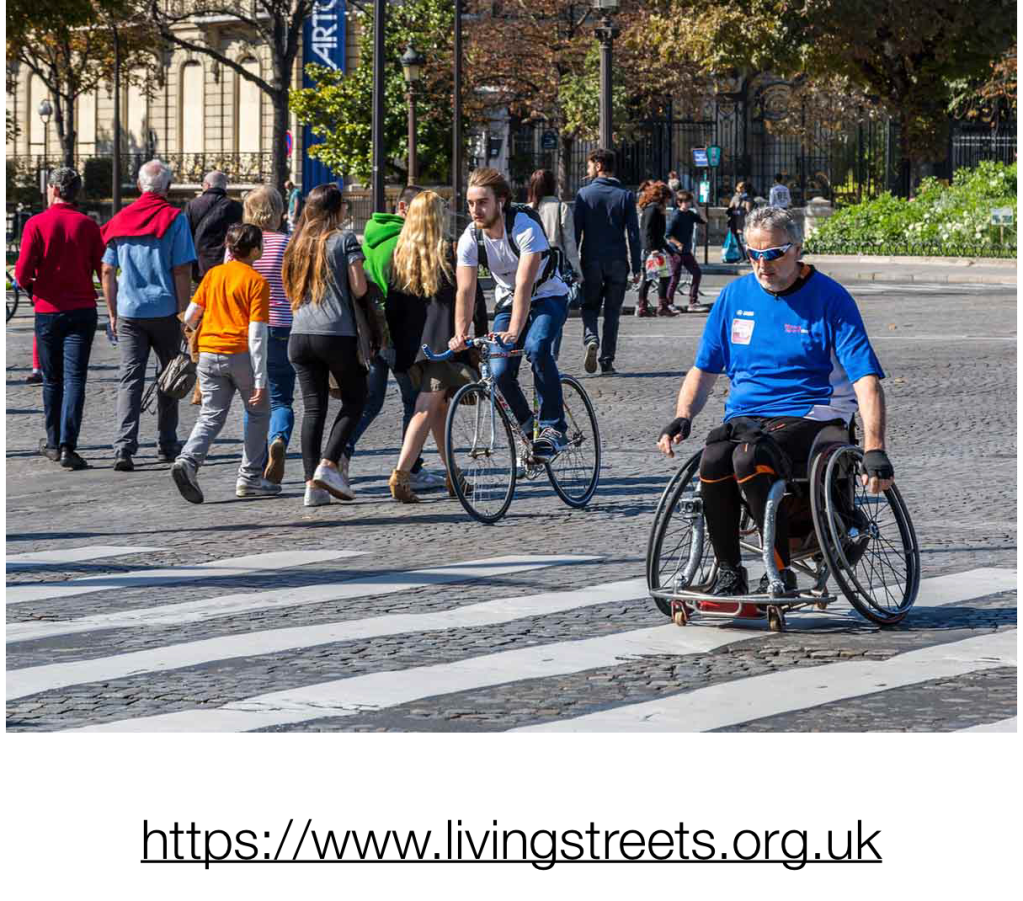
Wheeling: an equivalent alternative to foot/pedestrian-based mobility. Includes wheeled mobilities such as manual self- or assistant-propelled wheelchairs, including wheelchairs with power attachments or all-terrain attachments (such as the “Freewheel”), powered wheelchairs, mobility scooters (three and four-wheeled) and rollators. Some people rely on their cycle to move (at a pedestrian’s pace) through pedestrianised environments when it is not physically possible to walk/push their cycle. Some people use their cycle as a walking aid, by leaning on it (do not use crutches but need to lean in order to walk, due to pain etc. – they can dismount but cannot park their cycle). Some people use e-scooters (with or without a seat), to wheel/scoot through pedestrianised environment if they cannot walk unaided.

We recommend never using ‘walking’ on its own (as it likely reinforces ableist stereotypes in people’s minds) but always using ‘walking/wheeling’ together. Both words represent the action of moving at a pedestrian’s pace, whether or not someone is standing or sitting, walking/wheeling unaided or using any kind of aid to mobility, including walking aids / wheeled aids, personal assistants or support animals.

Cycling:  incorporates the action of moving at speed on a wide range of pedal- powered wheeled transport that may be powered with hands and/or feet, may transport one or more person, may or may not include e-assist and usually have between 2 and 4 wheels. 

https://wheelsforwellbeing.org.uk/walking-wheeling-and-cycling-definitions/embed/#?secret=7xNzMjwypv

Counting on …day 366

1st November 2022

Active travel – principally walking and cycling – is good for the participants mental and physical health and, because it doesn’t produce air pollution like motor vehicles, is good for everyone else breathing in the air.  It is also economical. Why then in the current economic and climate crisis would a government choose to cut funding that promotes active travel?

Join Active Travel and write to your MP asking that this funding be maintained –  https://action.cyclinguk.org/page/115055/action/1?locale=en-GB&en_chan=wa&en_ref=26096689

And at the same time lead by example and be active in travel. 

Counting on …day 298 

3rd September 2022 

Cycles of all shapes and sizes benefit from regular cleaning and maintenance: and you are rewarded with a speedy and comfortable ride. Even in the summer cycles get dirty with a grime that clogs moving parts. Once cleaned, lightly oil the chain. Check brakes and adjust or replace as necessary: in wet weather well adjusted brakes are an essential safety measure.

As the nights begin to draw in, make sure that you have a set of functioning front and rear lights.