Counting on …. Day 392

29th November 2022

Tomorrow is the feast of St Andrew, patron saint of Scotland. Here is a recipe for vegan haggis, not entirely my own, but  having no note of the original recipe, I cannot credit its creator.

Haggis. Serves 2-3

50g  Puy lentils

50g pearl barley

oil 

1 large onion, finely chopped

1 large carrot, finely chopped

75g portobello mushrooms, finely chopped

½ tsp ground allspice

 ½ tsp ground black or white pepper

90g pinhead oatmeal

½ tbsp marmite

1½ tbsp brown sauce or treacle

Sauté the onion and carrot in a little oil till soft. Add the mushrooms and the spices. If need be add a little more oil.

Add the barley and lentils. Add about 400ml hot water and yeast extract. Feel free to add a sprig of thyme. 

Simmer until the mixture is very thick, adding more water if necessary. 

Heat the oven to 180C/350F/gas mark 4.

Stir in the oatmeal and brown sauce and tip into a greased loaf tin and cover with foil. Bake for 30 minutes, then remove the foil and bake for another 30. 

Leave for five minutes, then turn out and serve.

 Counting on .. day 365

31st October 2022

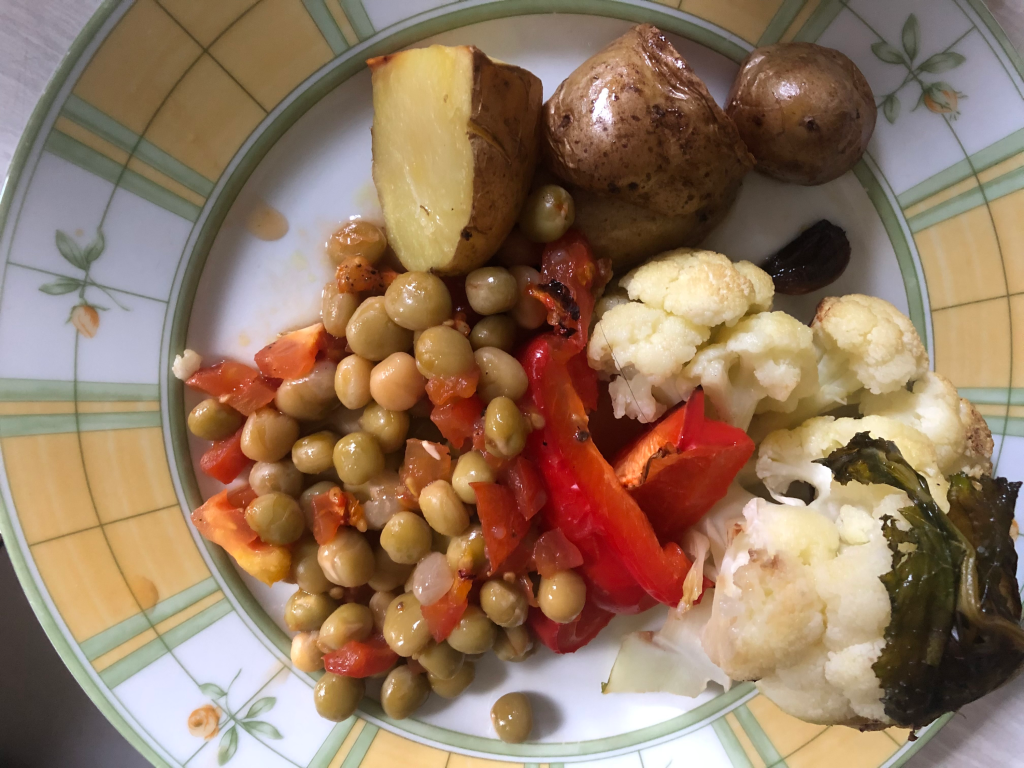
Can you challenge yourself to a plant-based November? With squashes and pumpkins and mushrooms and brassicas very much in season, lots of delicate and hearty meals await you. Try out a whole range of different plant-based proteins – fava beans, pinto beans, cannelloni beans, Puy lentils, Carlin peas, blue peas, black badger peas, tofu, walnuts, almonds …. I am sure you can have a different one each day!

Counting on … day 350

15th October 2022

Baking without using the oven. Ovens use a lot of energy, so  if you can avoid using them it helps reduce your carbon footprint. Instead you can use a heavy frying pan as a griddle and bake foods such as Welsh cakes, soda farls and potato farls, drop scones, griddle scones and Staffordshire oatcakes. 

Welsh cakes

250g plain or half and half plain and wholemeal plus baking powder

75g vegan butter

75g currants/ raisins

1 tbsp chia seeds soaked in a cup of hot water

1 tsp Nutmeg

A little oat milk

Lightly oil a flat based frying pan and set over a medium heat to warm up.

Rub the butter into the flour and add the remaining ingredients using enough oat milk to bind to a dough. Roll out about the thickness of a thumb and cut into rounds. 

Place the rounds into the pan. When they are browned on one side turn them over. 

Counting on …. Day 340

6th October 2022

According to Chatham House ‘a 15% reduction in pig and chicken consumption across the EU would have nullified the global grain shortage caused by the War in Ukraine.’ Eating less meat and dairy produce reduces demand for grain and other animal fodder, allowing production to be redirected to feeding people.  

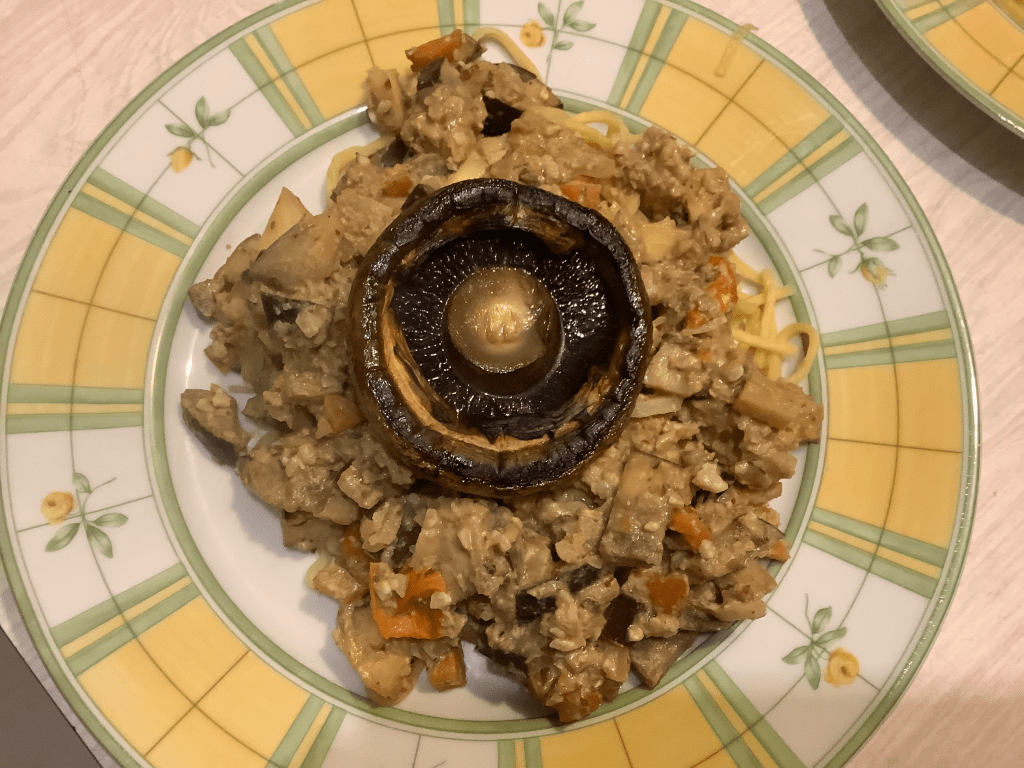
Aubergine with almonds

Chopped a couple of cloves of garlic and half an onion. Fry together with a chopped carrot and an aubergine, allowing the ingredients to cook and soften. 

Add 50g of chopped or roughly ground Spanish almonds.

Add a little miso sauce, a little tahini and enough water to bind into a sauce. 

Meanwhile cook some pasta  and (separately) fry a couple of portobello mushrooms.

This serves 2.

 Counting on… day 318 

24th September 2022

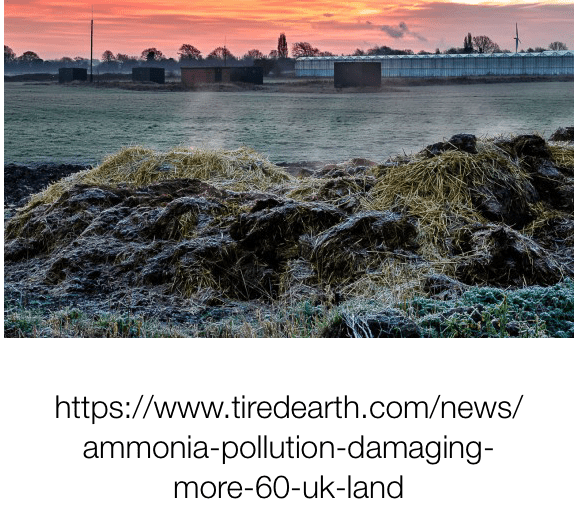
Manure and urine from farm animals is a major source of ammonia: in the UK 87% of ammonia released into the air comes from agriculture. Here ammonia reacts with other compounds in the air to form particulate matter that pollutes the air, irritating lungs and affect people’s breathing.  Ammonia also leads to the creation of smog, and the acidification of water and soil. It is harmful to plants and wildlife as well as humans. 

A particular concern at the moment is the health of the River Wye in Herefordshire. A large number of intensive chicken farms have been established in the Wye valley and the affluent from millions of chickens has created an algal bloom that is destroying the biodiversity of the river. 

This is another good reason for reducing our meat consumption. 

The Green Tau: issue 53

23rd September 2022

If we all went vegan what would happen to all the cows? 

This seems to be a frequent concern amongst those who are not vegan. If people didn’t eat meat or drink milk, would cows become extinct? 

The question is one of genuine concern but raises some other questions in response. For example what life does a cow have? Dairy cows will commence their milking life aged 2 when their first calf will be removed from her care within hours of birth.  She will then give birth once year, being milked for ten months producing quantities of milk (on average 8000 litres) greatly in excess of what a calf would consume. After 2.5 -4 years, when her milking yields drop, she will be slaughtered. The usual life expectancy of a cow is 20 years. Of her offspring, males calves will have a limited life to be slaughtered as veal at 5 – 7 months. Of her female calves most will follow in this mother’s footsteps unless they are deformed or ill, in which case they too will be slaughtered. 

Very few farmed cattle enjoy a full life. By contrast cattle kept on re-wilded land, although smaller in number, live a much more natural life. In the Lake District re-wilding projects are in place at Haweswater, Ennerdale and the Lowther Estate, whilst in Sussex there is the now famous Knepp Estate. According to Rewilding Britain 112,166 hectares of land are now part of a re-wilding project. 

So no, cows would not become extinct but would be kept in much smaller numbers – just as rare breeds of many farm animals are being conserved. 

In 2020 there were 9.36 million head of cattle in the UK. It was not always so! Originally there were only the early forebears of cattle, the aurochs. Overtime cattle were domesticated and as the human population of the UK grew so did the number of cattle. Selective breeding improved and diversified the      cattle with some favoured for milk production and others for meat. As the human and domestic animal populations increased, so the amount of uncultivated land and wildlife decreased: the auroch was hunted to extinction in the UK about 3000 years ago; the brown bear became extinct in the 6th century whilst the wolf hung on until the 17th century. What is true for the UK is also true world wide. Whilst once humans and domesticated animals were once nonexistent, they now comprise 36% and 60% of the biomass of all mammals, leaving just 4% as wild animals (biomass measures the quantity of a species by its mass rather than its numerical quantity).

Rather than it being a question of ‘what would happen to all the cows?’ perhaps the question should be ‘what has happened to all the wild animals?’ The State of Nature Report of 2019noted that since the 1970s, 41% of UK wildlife has declined, and that 26% of the UK’s mammals are at risk of becoming extinct. Re-wilding more of our land would help reverse this decline and allow for the reintroduction of lost species such as the lynx and the stork.

Globally 77% of agricultural land is used to feed livestock, including both grazing land and the land used to grow animal feed. In the UK 40% of the land (9.74 million hectares) comprisespermanent grazing, 6%  temporary grazing (1 – 5 years) and 5%  rough grazing. Only 20% of the land is used for arable crops. Even so home grown animal feed is supplemented by imports – somewhere in the region of 50%.

Globally the 77% of land used for grazing and feeding farm animals, produces only 18% of the world’s food calories. At the same time this major land use contributes more than half of the carbon footprint of our global food production. If everyone globally were to eat the same amount of meat as the average British person (approx 85g per day), then the amount of farm land needed would have to increase – putting even more pressure on natural habitats and wildlife. And if everyone were to eat as much meat as the average American, we would run out of land.

Reducing our consumption of meat and dairy products would release more arable land for growing more sustainably a great variety of plant-based proteins with the potential to improve the diets and health of billions of people world wide (subject to a radical improvement of trade and wealth distribution systems). Research the by the UN suggests that with fewer cases of lower coronary heart disease, strokes, type 2 diabetes and some cancers, a global vegan diet would also result in 8.1 million fewer deaths per year worldwide.

Britons have in fact already reduced their meat consumption by 17% over the last decade. The Government’s Food Strategy has the target of reducing that by 30% by 2030. This target has been set  in recognition of the adverse affect meat production has on both climate change and the environment, as well as the link between the consumption of red and processed meat the risk of developing cardiovascular disease, type 2 diabetes and certain types of cancer.

Looking to the future, there will be fewer cows – but hopefully they will be enjoying a happier life – and instead more land used to restore greater biodiversity. 

Further reading 

The Green Tau: issue 52

Positive Tipping Points

Scientists have long predicted tipping points in the climate crisis, vis events that will be triggered by rising temperatures and which will be irreversible even if temperatures fell. EG a temperature increase of 1.5C will cause the Greenland ice sheet to melt. Even if temperatures subsequently fall back that ice sheet cannot be recreated – it was the product of thousands of years of cold temperatures. 

The widespread destruction of the Amazon rain forest is leading to another tipping point where the loss of tree cover, and thus the ability of the ecosystem to absorb water, such that other trees cannot grow.

But there are also positive tipping points. For decades the petrol car has ruled supreme. Roads and service stations have all been developed to facilitate the use of the petrol car. The more ecological option of an electric vehicle has been slow to take off. The initial cost of each vehicle was high as productions numbers were low and scale of economies as yet untapped. Recharging points were limited in number and far apart as low numbers of vehicle discouraged investment. All these factors deterred would-be consumers, and expansion was therefore slow. However in recent years, rising demand has boosted the impact of change. Soon a tipping point will be reached where the number of electric cars produced and used in the UK will exceed those reliant on fossil fuels. The number of charging points will exceed petrol pumps. Petrol stations and the huge carbon footprint of vehicular transport will become a thing of the past. 

At present domestic heating is another big contributor to our national carbon footprint. The use of heat pumps and solar panels,  and the equipping of houses with double glazing and insulation, will be the norm, with the economies of scale and the increasing number of qualified technicians ensuring the affordability of these options. There will also be the swing in social norms that means that everyone will expect such technologies and the alternatives of  gas and oil fired boilers will be seen as antediluvian.

Whilst the number of people who follow a vegan diet has increased significantly, absolute numbers are still low as a proportion of the total population. So whilst the availability of plant based milks in cafés is widespread, there is not yet a comparable selection of vegan cakes and sandwiches. Whilst  in restaurants there may be the option of a vegan burger and possibly risotto, we are still waiting for the time when the dishes at the top of the menu are vegan and meat based items are the minority fare at the bottom of the menu. But when that tipping point is reached and the vegan diet is the norm, the carbon footprint for our food will be reduced by more than a third.

In the past we have seen positive social tipping points past. We have moved from a society in which wearing seat belts in cars went from being the exception to the norm. We have moved from viewing a last drink for the road as acceptable, to one that deplores drink driving and where taking a taxi after an alcoholic evening is the norm.  We have seen the change in expectation of maybe one holiday a year, typically in the UK, to two or three holidays a year with at least one involving taking a flight to hotter climes. 

In Sweden ‘flygskam’- flight-shame – has led to a fall in the number of people taking domestic flights and an increase in those travelling by train. Here in the UK Flight Free aims to persuade people to give up flying, not through shaming them, but through providing people with both illustrative information that shows the damage and pollution air travel causes, and testimonies from people who have made the Flight Free pledge. 

In the Netherlands 43% of people cycle everyday compared with 4% in the UK. Whilst a government survey found having off-road and segregated cycle paths (55%), safer roads (53%), and well-maintained road surfaces for cycling (49%) were most likely to encourage people to cycle more, there has not been sufficient investment to significantly improve the cycling infrastructure. In terms of tipping points, the more cyclists there are on a route, the more confident other cyclist feel about joining them. And the greater the likelihood of more investment!

We can all be part of the tipping process. If we make the beneficial changes the climate needs and talk about them with friends and family, at church, in the work place, at the gym and in the café or bar, the desire for change will grow in momentum and change will happen.

 Counting on … day 307

13th September 2022

Whilst harvest is often celebrated in September, harvesting is ongoing throughout summer and autumn. To provide for the winter months, fruits and vegetables as they are harvested, can be preserved as jams, chutneys and pickles or they can be bottled. All these methods of preservation don’t need a freezer or fridge. Follow this link for chutney-making and other  preserves https://greentau.org/tag/chutney/

With a glut of apples, this can also be a good time to make mincemeat ready for Christmas. Find a recipe here – https://greentau.org/2021/09/09/count-down-47/

Counting on … day 304 

9th September 2022

A resolution that is both environmentally kind and healthy, is to reduce the amount of meat and dairy products in your diet, replacing them with plant based foods instead – opt for those that are in season and locally grown. 

See these Eco Tips for switching to a vegan diet https://greentau.org/2021/10/12/eco-tips-11/

Or for a whole range of articles on vegan eating and recipes see https://greentau.org/tag/vegan/